Tag Archives: child poverty

In 2017, I brought water filters with me to visit our affiliated sites in India and Sri Lanka, thanks to our partnership with the nonprofit organization, Wine to Water. Wine to Water is based out of Boone, North Carolina, and works to provide clean water solutions to some of the more than 2 billion people globally who lack access to a safe water drinking source. The water filters, which I distributed to our volunteer coordinators along with instructions for use, can last for up to 10 years when maintained properly.

The water filters, which I distributed to our volunteer coordinators along with instructions for use, can last for up to 10 years when maintained properly.

Supporting communities in crisis

I have since stayed in touch with Wine to Water, following their international relief efforts, as well as their work in the United States to help communities in crisis — more recently having sent teams to Ukraine and Jackson, Mississippi in 2022.

When I found out I would be visiting the Philippines in early 2023, I spoke with our Director of International Programs, Luis Bourdet, to see if he thought I should once again request filters from Wine to Water for my trip. He asked our volunteer coordinators on my behalf, and they all agreed that yes, they would love to have water filters at our affiliated sites for the children to use for drinking and handwashing. Knowing I could get everything I needed to set up the filters once I arrived in the Philippines, I didn’t ask many more questions of our coordinators as I otherwise prepared for my departure, adding 20 water filters to my packing list.

The water filter is attached to the container on the counter and the clean water flows down to the container on the ground.

Both Joy at the Fortune Center in Manila and Nilo at the Pinagpala Center in Tagaytay were very excited to receive the filters and learn how they worked — by simply attaching them to a bucket, the filter works on gravity alone, and can filter out 99.999% of bacteria and microbes from unfiltered water, making it safe to drink even from dirty rivers or contaminated water sources. I was delighted that they thought the technology was as interesting as I found it to be, and so easy to use, which made it ideal for distributing to anyone willing to keep the filter clean and away from anything that could damage it.

A need for new filters

When I traveled to Tacloban City to meet with our volunteer coordinator, WimWim, from the Visayans Center, or VFV, I mentioned to her that I had the water filters with me, and she suggested that I bring them to the Santo Nino Center in a few days for our scheduled visit. There, she explained, they had a water tank for collecting water, but the water filters they had been using were getting older, and she was ready to replace them as well as add some additional ones.

When we arrived at the Santo Nino Center to prepare for the daily feeding program, I walked into the small one room building, and my eye was immediately drawn to a water storage container sitting on the kitchen counter. Attached to the container was the same exact water filter that I had brought with me — water filters that WimWim had yet to see because they were still in my book bag that I was wearing.

10 years after Yolanda

I excitedly told WimWim that I thought it was so strange that they had the exact same water filter already — although not an obscure product, still one I was very surprised to see. WimWim casually looked over at the filter, and said, “We received those from Wine to Water in 2013 after the Typhoon when they were here helping with the recovery efforts.”

I couldn’t believe what I was hearing. I responded slowly, so as to make sure no detail would be missed. “WimWim, did you know that the water filters I brought are also from Wine to Water?” She looked at me and shook her head, and we both started to laugh. What an amazing coincidence, I thought to myself.

I started asking WimWim a million questions about their work with Wine to Water ten years ago — how did they find out about VFV? Wine to Water had reached out. How many people from Wine to Water came to Tacloban? Two people from the organization visited at two different times in a two-year period. How many years have they been using the water filters? Between 5 and 10 years, depending on the filter. Did Wine to Water help in any other way? Yes, they dug a well, built the rainwater collection tank at the Santo Nino Center and at the Cancumbang Center, and provided enough filters for all three of the VFV centers to have clean water for a decade.

After switching out some of the older water filters with the ones I brought with me, we went about our visit to the center, meeting the children and their parents. When we returned to the VFV office later that day, I noticed two water filters in the kitchen that I had noticed only the day before — the following day, I got to see more filters in use at the Cancumbang Center. Just as I was, WimWim was grateful for the serendipitous nature of what had occurred. Almost exactly 10 years after Wine to Water had been in Tacloban to bring filters to the community, I had returned with new filters without even knowing ahead of time just how much it was needed.

***

How do I sponsor a child in the Philippines?

You can sponsor a child in the Philippines in one of three ways: call our office at 1-800-538-5381 and speak with one of our staff members; email us at sponsorship@children-inc.org; or go online to our sponsorship portal, create an account, and search for a child in the Philippines that is available for sponsorship.
SPONSOR A CHILD

In Africa, children living in poverty often face huge hurdles when it comes to getting an education. Often, particularly in the areas where Children Incorporated works in Africa, attending school requires fees for teacher salaries, uniforms, books, school lunches and even the use of a desk. For families who already struggle to make ends meet, sending children to school is often not an option. Even if parents can afford the school fees, impoverished households often do not allow for study time due to lack of electricity, crowded conditions in the home, or the need for children to work after school to help support their families. Children might not have enough food to eat at home, therefore going to school hungry and ill-prepared for the learning.

Our sponsors and donors provide basic necessities such as food, clothing, healthcare, and educational support to children living in poverty.

Shelley Callahan, Children Incorporated’s Director of Development, says, “What I have seen through my work with Children Incorporated, is that in Kenya and Ethiopia, families have a lot of difficulty choosing between sending their children to school and paying for housing and bills, because they can’t afford to do both. Our support is desperately needed to educate youth living in poverty in these countries, and that can be accomplished directly through sponsorship.”

 Facts about Childhood Poverty in Africa

  • The poverty rate in East Africa hovers around 40%, making it difficult for families to afford school fees
  • According to the World Bank, more than one-fifth of primary age children are not attending school
  • Girls are more likely than boys to stay out of school due to household responsibilities, menstruation, or because the family does not think it is important for a girl to be educated

WHAT CHILDREN INCORPORATED DOES TO SUPPORT CHILDREN’S EDUCATION

Children Incorporated provides resources to children in Africa through our sponsorship program because we passionately believe that children everywhere deserve education, hope, and opportunity. Our sponsors and donors provide basic necessities such as food, clothing, healthcare, and educational support to children living in poverty. These essentials are vital to a child’s growth and ability to attend school and succeed.

HOW YOU CAN HELP

You can help a child living in Africa receive an education by becoming a sponsor today. Sponsorship provides an underprivileged child with basic and education-related necessities such as food, clothing, healthcare, school supplies, and school tuition payments. This vital support allows impoverished, vulnerable children to develop to their full potential – physically, emotionally, and socially. Sponsors positively impact the lives of the children they sponsor through the simple knowledge that someone cares about their well-being. This gives children in need hope, which is powerful.

Our policy has always been to consider the needs of each sponsored child on an individual basis. We work closely with our volunteer coordinators at our affiliated sites, who are familiar with each individual circumstance and the needs of every child in their care. Our on-site volunteer coordinators use sponsorship donations to purchase basic and education-related items for children in our program, to ensure that they have what they need to do their very best and succeed in school.

***

HOW DO I SPONSOR A CHILD WITH CHILDREN INCORPORATED?

 You can sponsor a child with Children Incorporated in one of three ways: call our office at 1-800-538-5381 and speak with one of our staff members; email us at sponsorship@children-inc.org; or go online to our donation portal, create an account, and search for a child that is available for sponsorship.

SPONSOR A CHILD

Here at Children Incorporated, we know that sponsoring a child in need is extraordinarily rewarding, so we want to provide you with a guide to walk you through the process.

In order to make your decision as easy as possible, here you will find the answers to sixteen of the most common questions we receive about sponsoring a child in Arizona.

If you still have questions after reading the following, please feel to contact us, and we will be happy to help.

1. What is sponsorship?

The sponsorship relationship enables an individual sponsor to help support a child in need by means of monthly contributions. Monthly sponsorship donations go towards providing basic necessities such as school supplies and tuition fees, food, clothing, and access to healthcare, among other services, so that a child living in poverty has the opportunity to overcome the barriers that keep them from attending school, getting an education, and succeeding in life.

2. What is the role of A sponsor?

A sponsor’s friendship and encouragement are priceless to a child in such circumstances. Indeed, many children value the relationships they establish with their sponsors as much as they value the financial support they receive from them. There is an opportunity to build a relationship between sponsor and child that can be quite profound.

3. How long can I sponsor a child in Arizona?

Many children value the relationships they establish with their sponsors as much as they value the financial support they receive from them. There is an opportunity to build a relationship between sponsor and child that can be quite profound.

Typically, sponsorship lasts until a child turns eighteen years old, graduates from high school, or moves out of our service area. Due to the transient state of many families and the difficult circumstances of the regions where they reside, we cannot predict or guarantee how long a child will remain in our sponsorship program, although every effort is made to provide services to children for as long as possible.

When a child leaves the sponsorship program, another child is selected for you to sponsor that is equally in need, in the hope that you will accept the new sponsorship.

4. Who implements or administers the child sponsorship program?

Our program is implemented by on-site volunteer coordinators who are typically administrators at the projects with which we affiliate. Our coordinators have direct access to the children they serve at their schools, homes, orphanages, or community centers – and sometimes even on a daily basis. As such, they are familiar with the immediate needs and family circumstances of each individual child in their care.

5. HOW MUCH DOES IT COST TO SPONSOR A CHILD In Arizona?

With Children Incorporated, it costs $35 a month to sponsor a child living in poverty. Our sponsorship amount is lower than other sponsorship organizations because we work with volunteer coordinators around the world, which helps us keep our costs low while also maximizing the amount of money we are able to send to the children in our sponsorship program.

6. WILL MY SPONSORSHIP HELP A CHILD GO TO SCHOOL OR HELP WITH THEIR EDUCATION IN africa?

Yes! Absolutely — you sponsorship will help a child go to school or help with their education. Children Incorporated provides basic necessities such as food, clothing, healthcare and educational support to children living in poverty in the U.S. and abroad. These essentials, so often taken for granted, are vital to a child’s growth and success in school. Each year, we give thousands of children in need all over the world a chance at a better life by supporting their education.

7. ARE THERE NON-RELIGIOUS SPONSORSHIP ORGANIZATIONS?

Yes. Children Incorporated is a non-religious sponsorship organization. Children Incorporated is an independent charity. We have no religious or political affiliation. Our goal is to assist as many  children living in poverty as possible, and we respect each child’s religious and cultural heritage.

8. Who most directly benefits from my financial support?

When you sponsor a child, the beneficiary of your support is your individual sponsored child. The families of children in our sponsorship program receive additional or indirect benefits from their child’s sponsorship, but our focus is the one child. Sponsorship is intended to address the unique and individual needs of each child so that his or her specific needs are addressed.

The child-focused approach to fighting poverty is distinctly different from the broader community development approach. By changing the life of one child, you are giving him or her the opportunity to break the cycle of poverty, which can eventually lead to the transformation of an entire community – and even a nation.

9. WILL I RECEIVE UPDATED INFORMATION ABOUT MY SPONSORED CHILD IN Arizona?

Yes. You will receive updated information and an updated photo, although the frequency may vary depending upon the child’s location. The typical progress report includes information about the child’s grade level in school, hobbies, and interests.

10. May I send packages to my sponsored child in Arizona?

Due to high customs duties and the likelihood of loss, it is not recommended that you send packages to projects outside of the United States, as their receipt cannot be guaranteed. If you would like to send an additional gift, it is recommended that you send a monetary gift to our headquarters in North Chesterfield, Virginia.

11. May I write to the child I sponsor?

Yes! Corresponding with your sponsored child can be a delightful experience. Your sponsored child is encouraged to write to you as well.

12. What should I write about?

The children enjoy learning about the lives of their sponsors. Writing about your own family (children, grandchildren, brothers, sisters, etc.) is always a good place to start. The children also like to learn about your part of the world, what you do for a living, your hobbies and interests, and about any pets you may have.

13. Is it possible to visit my sponsored child in Arizona?

It is possible to visit sponsored children; however, it is not guaranteed that all of the projects with which we affiliate are open to sponsor visits. Circumstances vary from area to area.

14. Are there reviews of child sponsorship organizations?

Yes. Before you choose an organization with which to sponsor a child, we highly recommend that you visit these websites to gain a better understanding of charity backgrounds and performances: Charity Navigator, GuideStar, Give.org and Charity Watch.

Children Incorporated is very proud of our reputation and reviews that recognize the work we are doing for children. Visit the following links to see our ratings:


15. What are the best child sponsorship organizations for sponsoring a child in Arizona?

Well, we are obviously a little biased about this question; but as we mentioned above, we highly recommend that you visit the various websites that provide assessments and ratings of nonprofit organizations before you make any donations.

16. What are the pros and cons of sponsoring a child?

The pros: you get to make a fundamental difference in the life of a child in need, and the effects of your sponsorship can last a lifetime. There are no real cons to sponsoring a child, but as you follow the progress of your sponsored child, you may at times feel that you wish you could do more.

If you are interested in sponsoring a child in Arizona or elsewhere, please click here to get started.

SPONSOR A CHILD

written by Children Incorporated

We provide children living in poverty with education, hope and opportunity so they have the chance for a brighter future. Thanks to past and current supporters around the globe, we work with 225 affiliated sites in 20 countries to offer basic needs, emergency relief, and community support to thousands of children and their families each year.

» more of Children's stories

Here at Children Incorporated, we know that sponsoring a child in need is extraordinarily rewarding, so we want to provide you with a guide to walk you through the process.

In order to make your decision as easy as possible, here you will find the answers to sixteen of the most common questions we receive about sponsoring a child in Navajo Nation.

If you still have questions after reading the following, please feel to contact us, and we will be happy to help.

1. What is sponsorship?

The sponsorship relationship enables an individual sponsor to help support a child in need by means of monthly contributions. Monthly sponsorship donations go towards providing basic necessities such as school supplies and tuition fees, food, clothing, and access to healthcare, among other services, so that a child living in poverty has the opportunity to overcome the barriers that keep them from attending school, getting an education, and succeeding in life.

2. What is the role of A sponsor?

A sponsor’s friendship and encouragement are priceless to a child in such circumstances. Indeed, many children value the relationships they establish with their sponsors as much as they value the financial support they receive from them. There is an opportunity to build a relationship between sponsor and child that can be quite profound.

3. How long can I sponsor a child in Navajo Nation?

Many children value the relationships they establish with their sponsors as much as they value the financial support they receive from them. There is an opportunity to build a relationship between sponsor and child that can be quite profound.

Typically, sponsorship lasts until a child turns eighteen years old, graduates from high school, or moves out of our service area. Due to the transient state of many families and the difficult circumstances of the regions where they reside, we cannot predict or guarantee how long a child will remain in our sponsorship program, although every effort is made to provide services to children for as long as possible.

When a child leaves the sponsorship program, another child is selected for you to sponsor that is equally in need, in the hope that you will accept the new sponsorship.

4. Who implements or administers the child sponsorship program?

Our program is implemented by on-site volunteer coordinators who are typically administrators at the projects with which we affiliate. Our coordinators have direct access to the children they serve at their schools, homes, orphanages, or community centers – and sometimes even on a daily basis. As such, they are familiar with the immediate needs and family circumstances of each individual child in their care.

5. HOW MUCH DOES IT COST TO SPONSOR A CHILD In Navajo Nation?

With Children Incorporated, it costs $35 a month to sponsor a child living in poverty. Our sponsorship amount is lower than other sponsorship organizations because we work with volunteer coordinators around the world, which helps us keep our costs low while also maximizing the amount of money we are able to send to the children in our sponsorship program.

6. WILL MY SPONSORSHIP HELP A CHILD GO TO SCHOOL OR HELP WITH THEIR EDUCATION IN Navajo Nation?

Yes! Absolutely — you sponsorship will help a child go to school or help with their education. Children Incorporated provides basic necessities such as food, clothing, healthcare and educational support to children living in poverty in the U.S. and abroad. These essentials, so often taken for granted, are vital to a child’s growth and success in school. Each year, we give thousands of children in need all over the world a chance at a better life by supporting their education.

7. ARE THERE NON-RELIGIOUS SPONSORSHIP ORGANIZATIONS?

Yes. Children Incorporated is a non-religious sponsorship organization. Children Incorporated is an independent charity. We have no religious or political affiliation. Our goal is to assist as many  children living in poverty as possible, and we respect each child’s religious and cultural heritage.

8. Who most directly benefits from my financial support?

When you sponsor a child, the beneficiary of your support is your individual sponsored child. The families of children in our sponsorship program receive additional or indirect benefits from their child’s sponsorship, but our focus is the one child. Sponsorship is intended to address the unique and individual needs of each child so that his or her specific needs are addressed.

The child-focused approach to fighting poverty is distinctly different from the broader community development approach. By changing the life of one child, you are giving him or her the opportunity to break the cycle of poverty, which can eventually lead to the transformation of an entire community – and even a nation.

9. WILL I RECEIVE UPDATED INFORMATION ABOUT MY SPONSORED CHILD IN Navajo Nation?

Yes. You will receive updated information and an updated photo, although the frequency may vary depending upon the child’s location. The typical progress report includes information about the child’s grade level in school, hobbies, and interests.

10. May I send packages to my sponsored child in Navajo Nation?

Due to high customs duties and the likelihood of loss, it is not recommended that you send packages to projects outside of the United States, as their receipt cannot be guaranteed. If you would like to send an additional gift, it is recommended that you send a monetary gift to our headquarters in North Chesterfield, Virginia.

11. May I write to the child I sponsor?

Yes! Corresponding with your sponsored child can be a delightful experience. Your sponsored child is encouraged to write to you as well.

12. What should I write about?

The children enjoy learning about the lives of their sponsors. Writing about your own family (children, grandchildren, brothers, sisters, etc.) is always a good place to start. The children also like to learn about your part of the world, what you do for a living, your hobbies and interests, and about any pets you may have.

13. Is it possible to visit my sponsored child in Navajo Nation?

It is possible to visit sponsored children; however, it is not guaranteed that all of the projects with which we affiliate are open to sponsor visits. Circumstances vary from area to area.

14. Are there reviews of child sponsorship organizations?

Yes. Before you choose an organization with which to sponsor a child, we highly recommend that you visit these websites to gain a better understanding of charity backgrounds and performances: Charity Navigator, GuideStar, Give.org and Charity Watch.

Children Incorporated is very proud of our reputation and reviews that recognize the work we are doing for children. Visit the following links to see our ratings:


15. What are the best child sponsorship organizations for sponsoring a child in Navajo Nation?

Well, we are obviously a little biased about this question; but as we mentioned above, we highly recommend that you visit the various websites that provide assessments and ratings of nonprofit organizations before you make any donations.

16. What are the pros and cons of sponsoring a child?

The pros: you get to make a fundamental difference in the life of a child in need, and the effects of your sponsorship can last a lifetime. There are no real cons to sponsoring a child, but as you follow the progress of your sponsored child, you may at times feel that you wish you could do more.

If you are interested in sponsoring a child in Navajo Nation or elsewhere, please click here to get started.

SPONSOR A CHILD

written by Children Incorporated

We provide children living in poverty with education, hope and opportunity so they have the chance for a brighter future. Thanks to past and current supporters around the globe, we work with 225 affiliated sites in 20 countries to offer basic needs, emergency relief, and community support to thousands of children and their families each year.

» more of Children's stories

Here at Children Incorporated, we know that sponsoring a child in need is extraordinarily rewarding, so we want to provide you with a guide to walk you through the process.

In order to make your decision as easy as possible, here you will find the answers to sixteen of the most common questions we receive about sponsoring a child in Colombia.

If you still have questions after reading the following, please feel to contact us, and we will be happy to help.

1. What is sponsorship?

The sponsorship relationship enables an individual sponsor to help support a child in need by means of monthly contributions. Monthly sponsorship donations go towards providing basic necessities such as school supplies and tuition fees, food, clothing, and access to healthcare, among other services, so that a child living in poverty has the opportunity to overcome the barriers that keep them from attending school, getting an education, and succeeding in life.

2. What is the role of A sponsor?

A sponsor’s friendship and encouragement are priceless to a child in such circumstances. Indeed, many children value the relationships they establish with their sponsors as much as they value the financial support they receive from them. There is an opportunity to build a relationship between sponsor and child that can be quite profound.

3. How long can I sponsor a child in Colombia?

Many children value the relationships they establish with their sponsors as much as they value the financial support they receive from them. There is an opportunity to build a relationship between sponsor and child that can be quite profound.

Typically, sponsorship lasts until a child turns eighteen years old, graduates from high school, or moves out of our service area. Due to the transient state of many families and the difficult circumstances of the regions where they reside, we cannot predict or guarantee how long a child will remain in our sponsorship program, although every effort is made to provide services to children for as long as possible.

When a child leaves the sponsorship program, another child is selected for you to sponsor that is equally in need, in the hope that you will accept the new sponsorship.

4. Who implements or administers the child sponsorship program?

Our program is implemented by on-site volunteer coordinators who are typically administrators at the projects with which we affiliate. Our coordinators have direct access to the children they serve at their schools, homes, orphanages, or community centers – and sometimes even on a daily basis. As such, they are familiar with the immediate needs and family circumstances of each individual child in their care.

5. HOW MUCH DOES IT COST TO SPONSOR A CHILD In colombia?

With Children Incorporated, it costs $35 a month to sponsor a child living in poverty. Our sponsorship amount is lower than other sponsorship organizations because we work with volunteer coordinators around the world, which helps us keep our costs low while also maximizing the amount of money we are able to send to the children in our sponsorship program.

6. WILL MY SPONSORSHIP HELP A CHILD GO TO SCHOOL OR HELP WITH THEIR EDUCATION IN colombia?

Yes! Absolutely — you sponsorship will help a child go to school or help with their education. Children Incorporated provides basic necessities such as food, clothing, healthcare and educational support to children living in poverty in the U.S. and abroad. These essentials, so often taken for granted, are vital to a child’s growth and success in school. Each year, we give thousands of children in need all over the world a chance at a better life by supporting their education.

7. ARE THERE NON-RELIGIOUS SPONSORSHIP ORGANIZATIONS?

Yes. Children Incorporated is a non-religious sponsorship organization. Children Incorporated is an independent charity. We have no religious or political affiliation. Our goal is to assist as many  children living in poverty as possible, and we respect each child’s religious and cultural heritage.

8. Who most directly benefits from my financial support?

When you sponsor a child, the beneficiary of your support is your individual sponsored child. The families of children in our sponsorship program receive additional or indirect benefits from their child’s sponsorship, but our focus is the one child. Sponsorship is intended to address the unique and individual needs of each child so that his or her specific needs are addressed.

The child-focused approach to fighting poverty is distinctly different from the broader community development approach. By changing the life of one child, you are giving him or her the opportunity to break the cycle of poverty, which can eventually lead to the transformation of an entire community – and even a nation.

9. WILL I RECEIVE UPDATED INFORMATION ABOUT MY SPONSORED CHILD IN colombia?

Yes. You will receive updated information and an updated photo, although the frequency may vary depending upon the child’s location. The typical progress report includes information about the child’s grade level in school, hobbies, and interests.

10. May I send packages to my sponsored child in colombia?

Due to high customs duties and the likelihood of loss, it is not recommended that you send packages to projects outside of the United States, as their receipt cannot be guaranteed. If you would like to send an additional gift, it is recommended that you send a monetary gift to our headquarters in North Chesterfield, Virginia.

11. May I write to the child I sponsor?

Yes! Corresponding with your sponsored child can be a delightful experience. Your sponsored child is encouraged to write to you as well.

12. What should I write about?

The children enjoy learning about the lives of their sponsors. Writing about your own family (children, grandchildren, brothers, sisters, etc.) is always a good place to start. The children also like to learn about your part of the world, what you do for a living, your hobbies and interests, and about any pets you may have.

13. Is it possible to visit my sponsored child in colombia?

It is possible to visit sponsored children; however, it is not guaranteed that all of the projects with which we affiliate are open to sponsor visits. Circumstances vary from area to area.

14. Are there reviews of child sponsorship organizations?

Yes. Before you choose an organization with which to sponsor a child, we highly recommend that you visit these websites to gain a better understanding of charity backgrounds and performances: Charity Navigator, GuideStar, Give.org and Charity Watch.

Children Incorporated is very proud of our reputation and reviews that recognize the work we are doing for children. Visit the following links to see our ratings:


15. What are the best child sponsorship organizations for sponsoring a child in colombia?

Well, we are obviously a little biased about this question; but as we mentioned above, we highly recommend that you visit the various websites that provide assessments and ratings of nonprofit organizations before you make any donations.

16. What are the pros and cons of sponsoring a child?

The pros: you get to make a fundamental difference in the life of a child in need, and the effects of your sponsorship can last a lifetime. There are no real cons to sponsoring a child, but as you follow the progress of your sponsored child, you may at times feel that you wish you could do more.

If you are interested in sponsoring a child in Africa or elsewhere, please click here to get started.

SPONSOR A CHILD

written by Children Incorporated

We provide children living in poverty with education, hope and opportunity so they have the chance for a brighter future. Thanks to past and current supporters around the globe, we work with 225 affiliated sites in 20 countries to offer basic needs, emergency relief, and community support to thousands of children and their families each year.

» more of Children's stories

After spending the morning with Ester and WimWim, our volunteer coordinators at the Volunteer for the Visayans, it was time to get ready for the monthly distribution of supplies to the children in our program at the first of three affiliated sites in the Philippines I would be visiting during my time in Tacloban.

Located in the neighborhood of Bliss, VFV runs all of its citywide programs out of the same building where families also come to receive basic needs on a monthly basis.

We didn’t spend long traveling to the first site — in fact, all we had to do is walk downstairs from the office to the first floor of the building, and we had arrived! Located in the neighborhood of Bliss, VFV runs all of its citywide programs out of the same building where families also come to receive basic needs on a monthly basis and children come for the afternoon feeding program and tutoring support. The center also serves as the location where the volunteers with VFV come every morning to receive their assignments which include shopping for food, preparing meals, and helping feed the children each week.

Getting ready for distribution

Although the first floor of the center consists of only three small rooms — a front common area, a dining room, and a small kitchen — the space has been used very efficiently. Shelves lined the walls that were stocked with books, clothes, bags of rice, canned goods and other donations from the community. WimWim even showed me drawers filled with school supplies that had been built underneath the stairs to maximize storage, something I found to be so neat and creative.

Monthly distributions at the Bliss Center help ensure children and their families have basic necessities.

As other staff members started to arrive just shortly before 2 pm, the energy on the first floor started to rise quickly. It was obvious everyone was well-trained in the process of the distributions and each person had their own tasks to perform. Ester began opening rice bags and unpacking boxes of soaps and nonperishable food items along folding tables near the front windows of the building. WimWim and another staff member took folding chairs outside and lined them along the narrow sidewalk. A tarp was tethered to the outside of the building, as locals always anticipated the possibility of rain.

Other staff went over spreadsheets that had been prepared with the name of each sponsored child and the list of items they would be receiving — everyone receives the same items and an equal amount each month, but VFV still keeps meticulous records on each individual child.

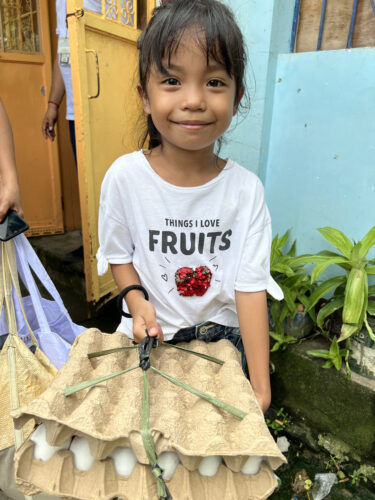
To increase the feeling of investment in the program for the families involved, it was expected that they bring their own reusable bags for rice, which had been made by VFV staff out of old vinyl and denim, as well as the egg crates they received during the last distribution to be refilled.

WimWim explained the importance of the structure that VFV has established over the many years they had been working in the community. WimWim herself has worked with the organization since 2005 — the same year the center opened in Bliss. She said they have had to learn a lot from trial and error about how to best support the community.

Even though life was tough for many families, struggling day to day to make ends meet, it truly did feel that all of them had found some bliss in this community.

She, having grown up in the area and currently living in the neighborhood herself with her husband and children, was very aware of how many families were living in poverty and really needed the help. But, she explained that, at the same time, she felt that when families don’t feel a connection with the center, then they don’t always remain consistent with participation, and that would cause issues.

The importance of sponsors

Sponsorship, as WimWim described, has always been a valuable means of keeping families involved with the center and making them feel a part of what VFV is doing to help. She said that not only do the sponsors ensure that the children have supplies on a regular basis, but it reminds them that someone cares about them, and that is powerful in showing families that there are ways out of the poverty in which they live. Additionally, thanks to VFV, families in Bliss can make a little extra income by offering to host their volunteers for a few weeks or a month at a time as a part of the center’s immersion program, which really increases their desire to be involved.

About 30 minutes after the staff started setting up, the children and the parents started to arrive, seating themselves outside, waiting patiently to be called into the center one at a time by Ester. I started to see how valuable it was for VFV to have this system in place — with more than 50 children to provide for in one afternoon, it took 2 ½ hours to get everyone their supplies, which would have taken so much longer if not for the process already in place.

Watching this well-oiled machine at work was a delight, and everyone seemed to be having a good time, as parents chatted with one another while waiting their turn, and children played with one another outside the center. Even though life was tough for many families, struggling day to day to make ends meet, it truly did feel that all of them had found some bliss in this community.

***

How do I sponsor a child in the Philippines?

You can sponsor a child in the Philippines in one of three ways: call our office at 1-800-538-5381 and speak with one of our staff members; email us at sponsorship@children-inc.org; or go online to our sponsorship portal, create an account, and search for a child in the Philippines that is available for sponsorship.

SPONSOR A CHILD